


Concrete Batching Plant Installation Guide
2026.07.15
Nearly 40% of the later-stage operational failures of concrete batching plants can be traced back to oversights during the installation phase. Unlike ordinary engineering equipment, a concrete batching plant is an integrated system combining steel structure, mechanical transmission, metering sensors, pneumatic and hydraulic systems, and electrical control. Its installation quality directly determines the plant's lifespan, metering accuracy, and maintenance costs. Truly professional installation is not simply assembling according to drawings, but rather follows the principles of "precision first, from static to dynamic, and step-by-step verification," ensuring thorough process control at each critical juncture. A standardized concrete batching plant installation process typically consists of five core stages: foundation construction and embedded part placement, main structure hoisting and positioning, assembly of the conveying and metering systems, placement of concealed works such as pneumatic, lubrication, and electrical systems, and step-by-step commissioning and joint testing and acceptance.
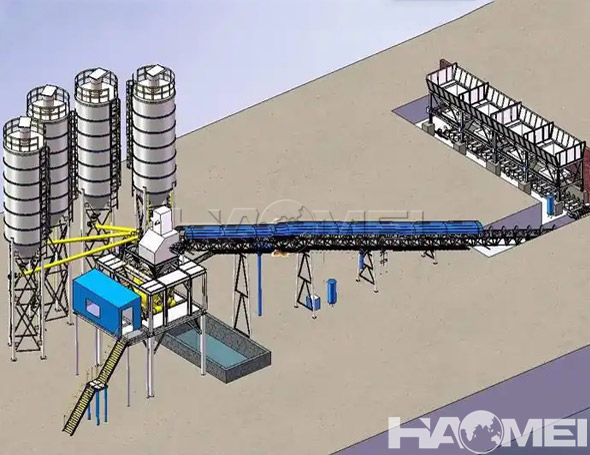
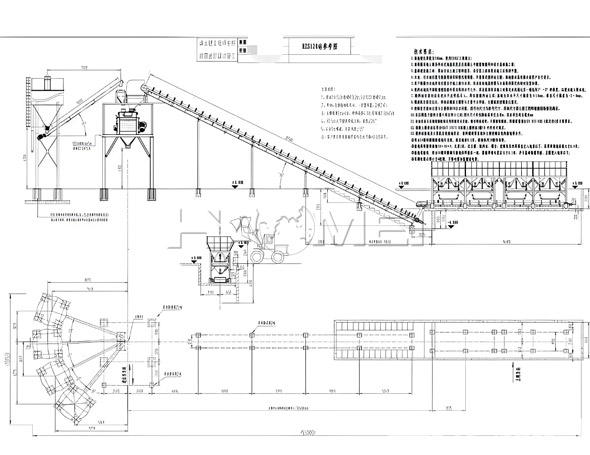
Foundation construction and embedded part positioning are the benchmark for the entire equipment installation and are also the most easily overlooked aspect. Many projects only focus on concrete strength, neglecting the levelness of the foundation plane and the relative positional errors of the embedded parts. If the elevation deviation of the silo foundation, main unit base, and conveyor support legs exceeds 2mm, internal stress will be generated after the steel structure is in place, which may lead to weld cracking and support deformation during long-term operation. The professional practice is to perform a second leveling after the foundation is poured, re-measure each group of embedded parts point by point with a level, and reserve settlement observation points at the four corners of the silo. Settlement data should be recorded before installation and after heavy loading to ensure uniform foundation bearing capacity.
The installation of the main structure should follow the logical sequence of "fixed ends first, then free ends." Prioritize the installation of fixed main structures such as powder silos and the main building steel structure. After verticality calibration and final tightening of anchor bolts, then install connecting components such as aggregate batching machines and conveyor belt corridors in sequence. The installation accuracy of the main unit base is of paramount importance; it must be calibrated simultaneously in two orthogonal directions with a level to ensure the base flatness is ≤1mm/m. After the mixing shaft is installed, a separate coaxiality re-measurement should be performed to prevent premature failure of the shaft end seal due to uneven wear. Many concrete batching plants experience frequent grout leakage and abnormal bearing noise later on, the root cause of which lies in the neglect of subtle deviations during the installation of the main unit.
The core of installing conveying and metering systems lies in the pre-calibration of dynamic balance. When installing screw conveyors, the coaxiality of the inlet and outlet ends must be strictly controlled. Errors cannot be compensated for by forcibly connecting flanges; otherwise, the central suspension shaft will experience abnormal wear due to radial force. For belt conveyors, in addition to the conventional frame alignment, no-load alignment should be performed after all idlers are installed. This involves adjusting the parallelism of the front and rear rollers and the angle of the idlers to ensure the belt does not deviate under both no-load and half-load conditions. The metering system requires sensor pre-pressure and zero-point calibration under no-load conditions to ensure the scale body is free of additional jamming and that the force is evenly distributed. If this step is left until after material feeding, the metering accuracy will always have a systemic deviation.
The pneumatic, lubrication, and electrical systems are concealed works, and their installation quality directly affects operation and maintenance costs. After the air pipeline is installed, a pressure test must be performed. The pressure drop should not exceed 0.05 MPa after standing at rated pressure for 30 minutes to be considered合格 (qualified). This prevents frequent start-stop cycles of the air compressor due to air leaks later. For centralized lubrication pipelines, grease should be drained point by point after filling to ensure grease overflows from each lubrication point and prevent dry running caused by pipeline blockage. For the electrical components, focus on grounding resistance testing and shielded wiring. Sensor signal lines and power lines should be laid separately to reduce signal interference.
Finally, the commissioning phase should adhere to the principle of "step-by-step testing, then integrated commissioning": first, test the individual units under no-load, then test each system with materials, and finally, achieve integrated production of the entire concrete batching plant. Record operating parameters at each step, and only proceed to the next step after confirming that there are no abnormalities in the previous step. This method makes it easier to locate problems than starting the entire plant at once.
In short, the installation of a concrete batching plant is not a simple assembly process, but the starting point of the equipment's entire life cycle. Implementing precision control and process verification during the installation phase lays a solid foundation for long-term, efficient production.


