





How To Install Concrete Batching Plant Correctly?
2026.09.30
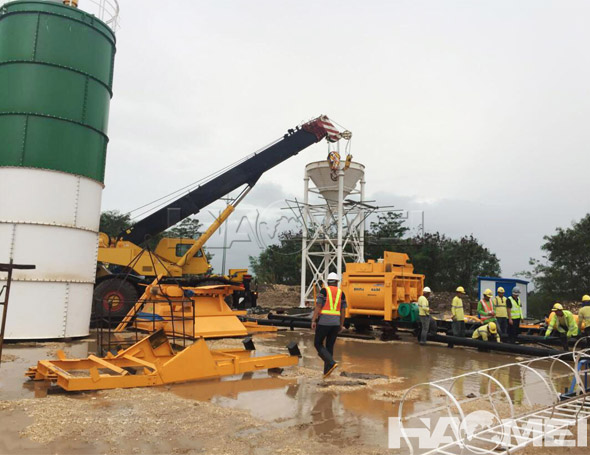
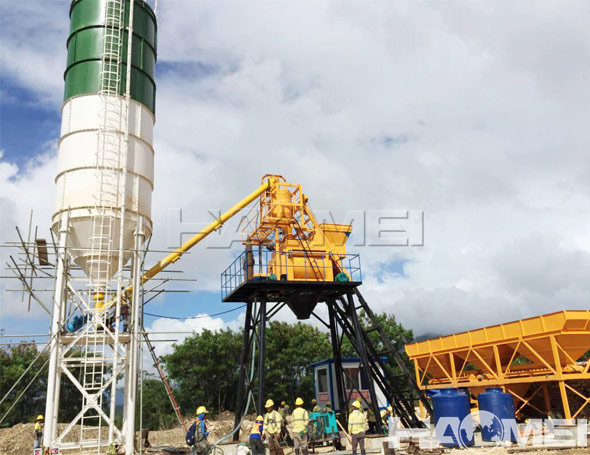
The installation quality of a concrete batching plant directly determines its operational stability, metering accuracy, and service life after commissioning; approximately 30% of early-stage failures in the industry can be traced back to process deviations during installation. Drawing on Haomei Machinery’s extensive experience in supervising overseas installations, the setup of HZS-series stationary concrete batching plants proceeds through five stages: foundation acceptance, main structure hoisting, piping connection, electrical commissioning, and integrated trial operation. Each stage incorporates specific, quantifiable technical control points.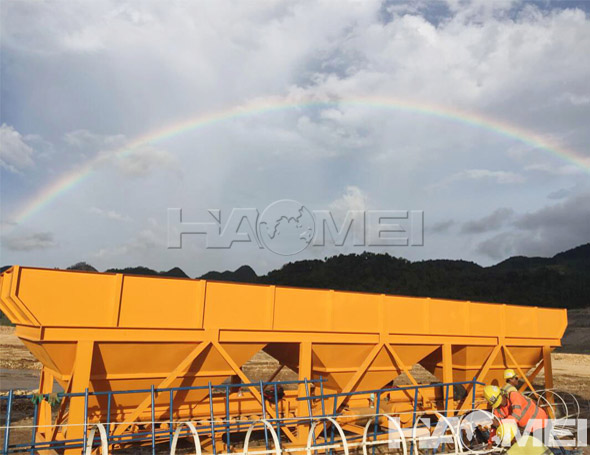
Foundation acceptance is the primary step.
The equipment foundation must be cast using concrete with a strength grade of C30 or higher; positional deviation for embedded anchor bolts must be controlled within ±2 mm, and the levelness deviation of the foundation's top surface must not exceed 2 mm/m. A curing period of at least 28 days is required, and hoisting operations may only commence once the concrete strength reaches 100% of the design value. For construction during the rainy season, drainage ditches must be installed around the foundation to prevent rising groundwater levels from compromising the anchor bolts' holding capacity—a measure particularly critical in the high-rainfall regions of Southeast Asia and Africa.
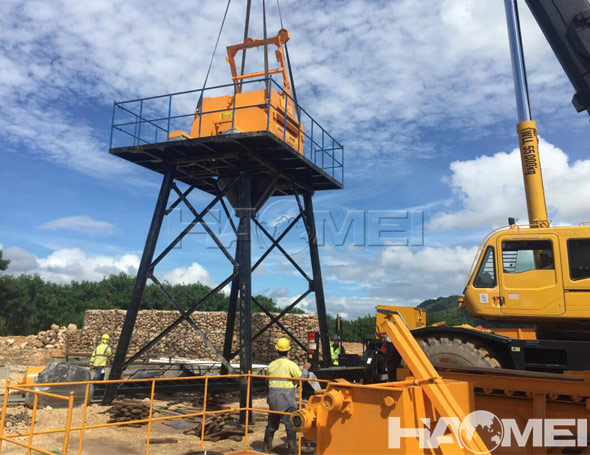
Hoisting of the main structure follows a bottom-up sequence, prioritizing core components before auxiliary ones.
First, the base of the main mixing tower is hoisted and leveled using the central column as a reference, with base levelness controlled to within 1.5 mm/m. Subsequently, the main mixer unit, metering hopper section, powder transition section, and top platform are installed in order. Once the twin-shaft mixer is positioned, a feeler gauge is used to check the contact gap between the chassis and the base; a gap of ≤0.1 mm is acceptable, with any localized gaps corrected using adjustment shims. For the 1,000-ton class powder silo—weighing approximately 18 tons—a truck crane with a capacity of over 50 tons is required for upright hoisting. After the silo is positioned vertically, the verticality of the cylinder wall is calibrated (with a total height deviation of ≤H/1000 and no more than 15 mm) before the anchor nuts are tightened.
Installation of the aggregate batching machine and the belt conveyor feeding system follows next.
For the batching machine frame, the longitudinal straightness deviation must be ≤3 mm; weighing hoppers must be independently suspended to avoid rigid interference with the frame. Regarding the belt conveyor frame, joint misalignment must be ≤1 mm, and no-load belt drift must be ≤5% of the belt width. The screw conveyor connecting the powder silo to the main unit's inlet must be installed at an angle of 20°–30°, with flange parallelism deviation ≤0.5 mm at both ends to prevent abnormal wear on hanger bearings.
Piping and electrical wiring constitute the final precision assembly phase.
The pneumatic system must maintain pressure for 30 minutes after being charged with 0.7 MPa compressed air; a pressure drop of ≤0.05 MPa is acceptable. Water and admixture lines must undergo individual pressure testing to ensure no leaks. Electrical wiring follows the sequence of main control cabinet → sub-control boxes → sensors → actuators, with cables protected by conduits; motor insulation resistance must be ≥0.5 MΩ, and the system grounding resistance ≤4 Ω.
Integrated trial operation is the final acceptance milestone.
First, "jog" the motors to verify correct rotation direction, then run the system in sections without load for at least 4 hours; during this time, temperature rise in gearboxes must be ≤40°C and in bearings ≤35°C, with no abnormal belt drift. Next, perform static calibration using standard weights in incremental steps; metering errors must be ≤±2% for aggregates and ≤±1% for powders, water, and admixtures. Finally, complete at least three cycles of integrated trial production to verify the proper functioning of discharge gate operation, signal interlocks, and data transmission.
Practical experience from projects shows that installation teams most often overlook two aspects: verifying embedded foundation parts against the equipment delivery drawings, and performing a secondary precision alignment of the main unit's mixing shaft. It is recommended that the concrete batching plant manufacturer's technical staff provide on-site briefings before installation begins and supervise key milestones; this approach can reduce the failure rate during the first three months of operation by more than 60%.

Maybe you also like
▶ Previous:Four Measures for Concrete Batching Plants in Tropical Climate
▶ Next:Back To List

