


How to Maintain a Concrete Batching Plant?
2026.11.18
A scientific and standardized maintenance system is the cornerstone for ensuring the weighing accuracy, operational stability, and service life of a concrete batching plant. By adhering to industry standard and leveraging industry operational data, a standardized maintenance regimen can reduce the annual equipment failure rate by over 40% and extend the total service life of the concrete batching plant by 3 to 5 years. Drawing on Haomei Machinery’s global project operation and maintenance (O&M) experience, the maintenance of a concrete batching plant should follow the principles of tiered management and specialized care, encompassing all core operational nodes of the entire system.
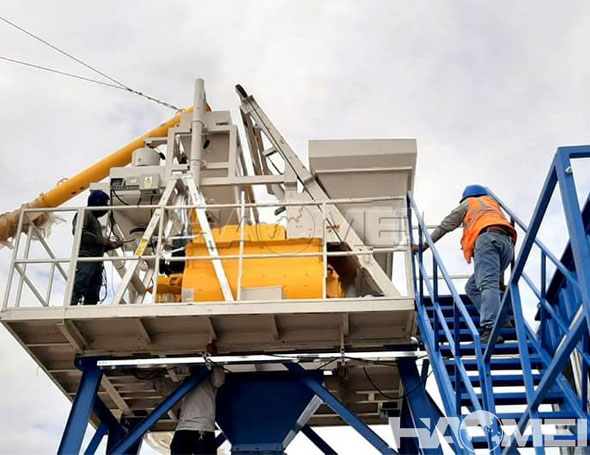
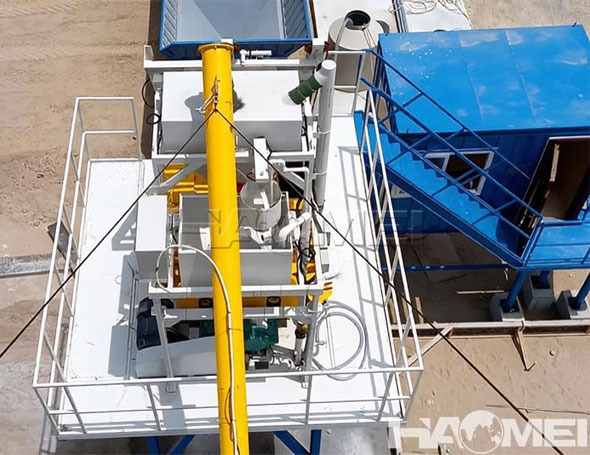
Daily maintenance serves as the foundation of the overall system and must be strictly executed during every shift.
Before the shift begins, perform checks on key points and calibrate baselines: ensure the gap between the mixing blades and the liner plates is within 5mm; verify that the oil level in the gearbox is within the specified range and that there are no leaks at the shaft-end seals; perform zero-point calibration for all weighing hoppers and clear any residual material to ensure accurate measurement; check the status of belt conveyors, ensuring lateral deviation does not exceed 5% of the belt width; and confirm that emergency stop devices and safety interlocks are fully functional. During production, continuously monitor operational parameters—such as the mixing unit’s current, weighing deviations, bearing temperature, and pneumatic system pressure. If any anomalies arise, shut down the equipment immediately for inspection; operating machinery while it is faulty is strictly prohibited.
At the end of each production shift, the inner walls of the mixing unit, the discharge chute, and the conveyor belts must be flushed with high-pressure water. This ensures the complete removal of residual concrete, preventing material from hardening and causing damage to equipment components. Additionally, accumulated water should be drained from air reservoirs and oil-water separators, and the dust collector’s hopper should be cleared to maintain the overall cleanliness of the equipment.
Periodic maintenance is structured into weekly, monthly, and annual intervals, with the depth of maintenance increasing at each stage.
Weekly maintenance focuses on the drive and pneumatic systems: applying the appropriate lubricant to all lubrication points to ensure smooth operation of joints and bearings; testing the pneumatic system for leaks (ensuring a pressure drop of no more than 0.05 MPa over 30 minutes at a pressure of 0.7 MPa); and monitoring the pressure differential across the pulse-jet dust collector filter bags—if the differential exceeds 1200 Pa, the bags must be cleaned or replaced.
Monthly maintenance centers on performance calibration and wear inspection: performing static self-calibration of weighing units using standard test weights to correct system deviations (ensuring an error margin of ≤±2% for aggregates and ≤±1% for powders, water, and admixtures); measuring the wear on mixing blades and liner plates (with a design service life of at least 40,000 batches for forced-action mixer liners—replacements are required when the remaining thickness falls below two-thirds of the original); checking that motor insulation resistance is at least 0.5 MΩ; and tightening electrical terminals to eliminate potential electrical hazards.
Annual overhauls aim to restore the equipment to its full operational capacity: replacing the industrial gear oil in the mixing unit’s gearbox (the first change occurs after 500 hours of operation, with subsequent changes every 2,000 hours); commissioning a professional third-party organization to conduct mandatory calibration of the weighing systems and issue a calibration report; testing the pressure safety valves on powder silos; inspecting the anti-corrosion coating on steel structures (ensuring a thickness of at least 80 μm and touching up any damaged areas); and verifying that the equipment foundation settlement deviation is ≤2 mm/m, while checking for any risks of structural deformation.
Based on practical experience from overseas projects, maintaining an advance inventory of spare parts is a critical measure for minimizing losses caused by equipment downtime. For overseas projects, supply chains are often long, with procurement lead times for wear parts typically ranging from 15 to 30 days—a duration during which a single day of downtime can result in tens of thousands of dollars in lost production capacity. Haomei Machinery recommends that clients maintain a 3-to-6-month stock of essential original-manufacturer wear parts, such as mixing blades, liner plates, seals and sensors.
Proper maintenance management can limit annual downtime for a concrete batching plant to under three days and reduce operation and maintenance costs per unit of output by 15% to 20%—a key strategy for enhancing overall project profitability. Haomei Machinery’s HZS series concrete batching plants utilizes standardized, interchangeable wear parts, keeping procurement costs below the industry average. Supported by full-lifecycle technical services, these solutions help clients achieve highly efficient, low-consumption production operations.


