

3 Types of Mini Concrete Plant For Sale
2026.08.05
In the small-to-medium-sized infrastructure and commercial concrete market, there is a wide variety of mini concrete plants in the 25-60m³/h range, with significant differences in naming and configuration. Buyers can easily fall into the misconception of "only looking at the nominal capacity." In reality, these devices are not simply different in capacity; rather, they have differentiated into three technical routes based on three core requirements: space, efficiency, and flexibility, each corresponding to different construction scenarios and operational needs.
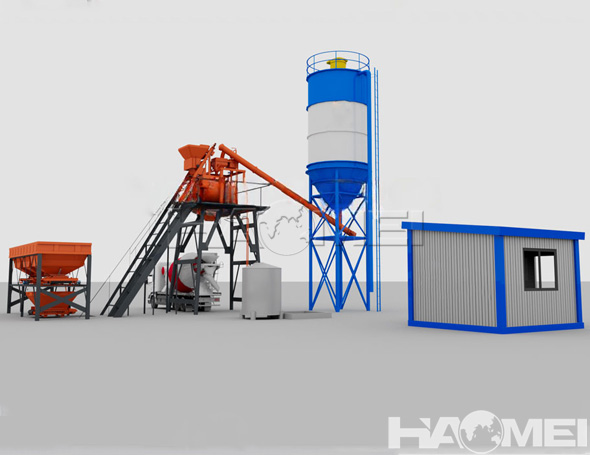
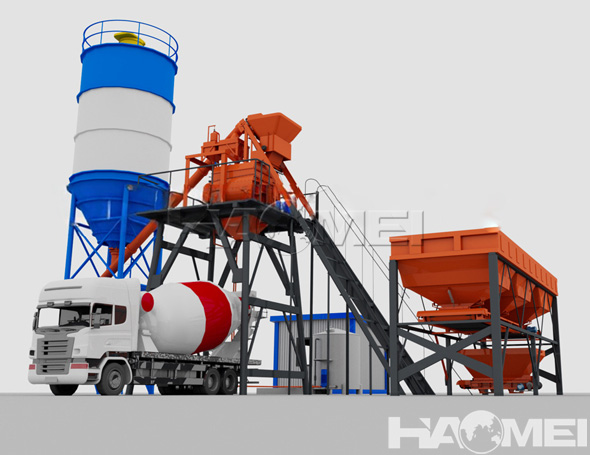
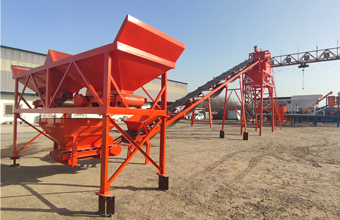
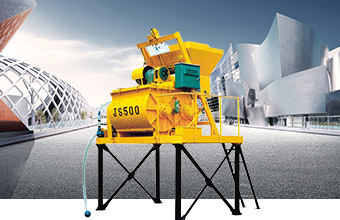
The first type is the space-efficient type: skip hopper type concrete plant, which is also the most classic configuration among small plants. This type of mini concrete plant equipment uses lifting buckets to vertically transport aggregates, eliminating the need for inclined belt conveyor corridors, resulting in a compact overall layout. Its horizontal length is about 30% shorter than belt conveyor plants of the same capacity. The mainstream models cover three ranges: HZS25, HZS35, and HZS50, equipped with JS500, JS750, and JS1000 twin-shaft forced-action main engines respectively, with nominal discharge capacities of 500L, 750L, and 1000L. The standard mixing cycle is 60-72 seconds, and the theoretical production capacity is consistent with the model specifications. The metering system is equipped with an independent electronic weighing module as standard, with aggregate error ≤±2% and powder and admixture error ≤±1%. The finished product quality fully complies with EN 206 international standards. Its core advantages are small footprint, low civil engineering costs, and low initial investment. Taking HZS35 concrete batching plant as an example, the entire station occupies only about 10m × 6m, making it very suitable for urban construction sites with limited space, small prefabrication plants in towns and villages, and small and medium-sized contractors with limited budgets. However, due to the intermittent feeding limitation of the bucket elevator, the continuous operation production rate is about 70%-80%, making it more suitable for scenarios with non-continuous feeding.
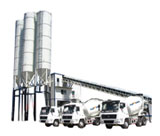
The second type is the stable efficiency type: belt conveyor type concrete plant, a mass production-oriented solution for small plants. 60 m³/h is the mainstream capacity for this type, equipped with a JS1000 twin-shaft main unit and a trough-type inclined belt for continuous feeding, achieving a conveying efficiency of over 120 t/h. The aggregate supply rhythm perfectly matches the mixing cycle, with no waiting intervals. Under continuous operation, the actual stable production capacity can reach 50-55 m³/h, with a production rate consistently above 85%, significantly better than skip hopper type concrete plant of the same capacity. Belt conveyor concrete plant equipment has a mature structure, stable operation, and low failure rate. The main unit liner and blades are made of high-manganese steel, with a normal operating life exceeding 7000 hours, and long-term maintenance costs are controllable. Although it occupies slightly more space than the skip hopper type, its advantages lie in its stable production capacity and ability to support two-shift continuous production, making it ideal for medium-sized municipal projects with a construction period of over 6 months, small-scale commercial concrete plants in counties, and precast component factories with high requirements for material supply rhythm. All models come standard with a PLC automatic control system, enabling full automation of the batching, mixing, and unloading processes with a low operating threshold.
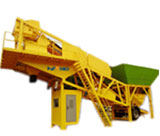
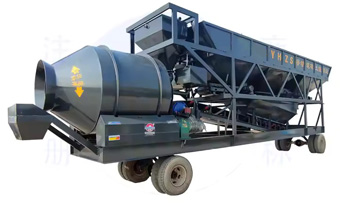
The third type is the flexible relocation type: mobile concrete batching plant, which has been the fastest-growing category in overseas engineering markets in recent years. Representative models are YHZS25 to YHZS60. Its core feature is the integration of batching, mixing, metering, and control room all onto a heavy-duty steel chassis. The entire unit can be towed by a semi-trailer for relocation without disassembly. It requires no permanent concrete foundation; only a leveled and compacted hardened ground is needed for placement. On-site commissioning can be completed in 2-3 days, and metering accuracy does not need to be recalibrated during relocation and resumption of work. The core mixing and metering configuration is completely consistent with the fixed type of the same specification, maintaining the same production capacity. It is suitable for linear projects with multiple locations and short cycles, such as rural road network reconstruction and expansion, distributed wind power foundations, and municipal emergency repairs. One unit can cover multiple construction sites, increasing the overall reuse rate by more than 60% compared to fixed units, resulting in significant advantages in overall construction costs.
All three types of mini concrete plants are CE certified, support 380V/415V multi-voltage systems and multilingual operating interfaces, and are adaptable to power grids and compliance requirements in different regions worldwide. For purchasers, there is no single "best" option, only the solution best suited to their specific needs: skip hopper type for limited space, belt conveyor type for stable mass production, and mobile type for frequent relocation. Major manufacturers like Haomei Machinery can provide customized configuration suggestions to help customers accurately match their requirements.


