

Skip Hoist Concrete Batching Plant
2025.12.10
Skip hoist concrete batching plant is a common type of small to medium-sized concrete production equipment. They utilize skip bucket elevators to vertically transport raw materials, offering advantages such as compact structure and small footprint. The vertical conveying structure allows for large-capacity material lifting even in limited spaces. This structure not only saves ground space but also reduces equipment investment costs to some extent. This advantage is particularly significant for construction sites in urban centers or with limited space.
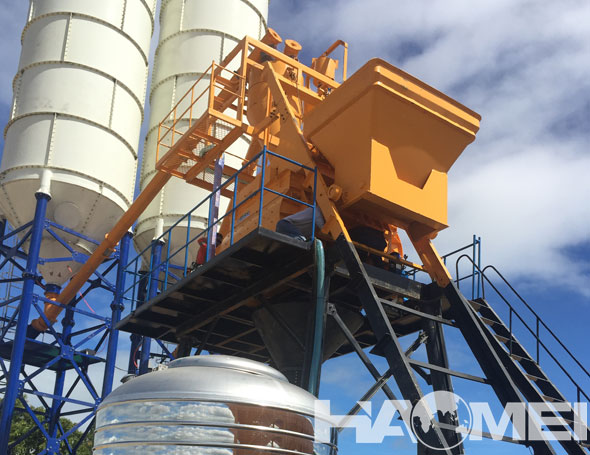
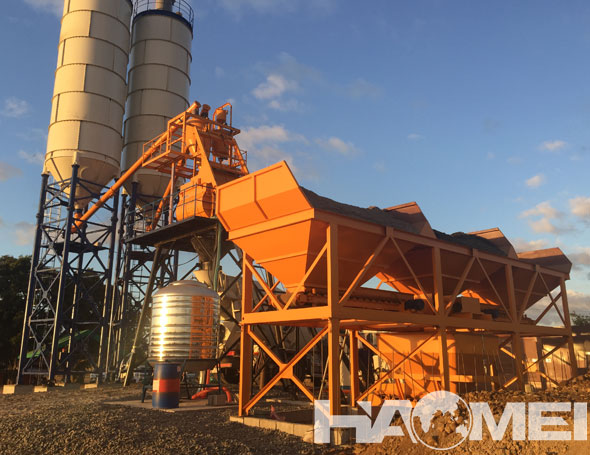
Taking the HZS skip hoist concrete batching plant as an example, this series includes models such as HZS25, HZS35, and HZS50, with a theoretical production rate between 25-50 m³/h. The main power varies from 22×2kW to 55×2kW depending on the model. Basic components of a HZS skip hoist concrete batching plant:
Skip bucket elevator:
The core conveying equipment, it lifts raw materials such as sand, gravel, and cement from a low position to a high position through the circulating movement of the buckets, achieving vertical transport.
Concrete mixer:
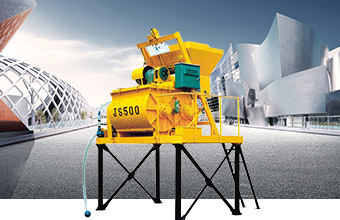
Typically a twin shaft horizontal forced concrete mixer or planetary concrete mixer is used, capable of quickly and uniformly mixing cement, aggregates, and concrete admixtures into a homogeneous concrete mortar.
Batching system:
Includes a concrete batching machine and metering devices, allowing for precise measurement of various raw materials to ensure concrete quality.
Storage system:
Generally consists of cement silos, aggregate silos, etc., used to store raw materials such as cement, sand, and gravel.
Control system:
Equipped with an automated control system, enabling automated control of the production process and adjustment of the mixing process.
Working Principle: After the batching machine completes the batching, the aggregates enter the bucket elevator hoppers. The hoppers are lifted upwards along the track by wire ropes or chains. When they reach the discharge area of the concrete mixer platform, the discharge gate opens, and the aggregates directly enter the mixing drum, where they are mixed with cement, water, and other raw materials in proportion to form concrete.
The core of a skip hoist concrete batching plant lies in the design of its skip bucket elevator. This design makes raw material transportation more efficient, especially in high embankments and narrow spaces. Skip bucket elevators can transport raw materials such as cement and sand from storage silos to the concrete mixer's feed inlet. Compared to traditional belt conveyors, skip bucket elevators reduce the footprint and improve overall space utilization. At the same time, the lifting speed and accuracy of bucket elevators ensure a stable supply of raw materials, avoiding production stoppages due to untimely supply.
Advantages of a skip hoist concrete batching plant including:
Small footprint:
Skip bucket elevators have a compact structure, effectively reducing the footprint of the mixing plant compared to belt conveyors, making them suitable for sites with limited space.
Easy Installation: Most adopt a modular design, making installation and relocation convenient and allowing for quick deployment.
High conveying efficiency:
Enables continuous conveying with fast lifting speeds, meeting the production needs of mixing plants and improving production efficiency.
Good sealing:
Provides excellent sealing, effectively preventing raw material leakage and dust emission, reducing environmental pollution.
Skip hoist concrete batching plants are widely used in small to medium-sized construction projects, road and bridge engineering, and precast concrete product plants, providing consistently high-quality concrete for various projects. Whether it's basic construction in residential areas or the renovation of urban infrastructure, these concrete batching plants can be adjusted according to actual conditions to achieve optimal production results.


