

Stationary Concrete Mixer Plant Selection Guide
2026.08.12
Many clients fall into the trap of "model-only" selection when purchasing stationary concrete batching plants, focusing solely on the nominal capacity figures. This often results in either idle capacity leading to wasted investment or insufficient material supply slowing down project schedules. In reality, stationary concrete mixer plants are long-term production assets. The essence of selection is a precise match between project needs and equipment parameters. A comprehensive evaluation from four dimensions—capacity, site, core configuration, and long-term value—is crucial to avoid parameter traps and select a truly suitable solution.
First: Capacity matching—Calculate real needs, avoid blindly pursuing high capacities.
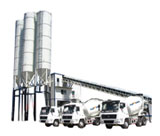
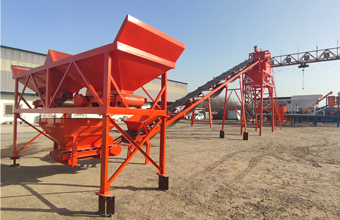
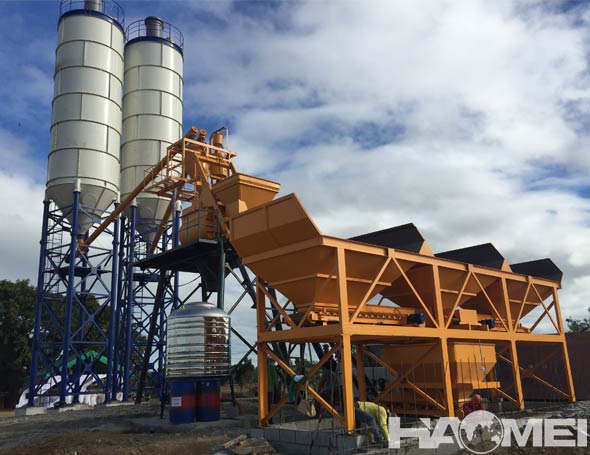
The core misconception in selection is directly comparing theoretical capacity to project needs, ignoring differences in actual production rates. Stationary concrete batching plants are divided into two types based on their feeding methods: bucket elevator type and belt conveyor type. Under the same nominal capacity, the actual continuous production rate can differ by more than 15%: skip bucket type is limited by intermittent feeding, with a production rate of approximately 70%-80%; belt conveyor type provides continuous feeding, with a stable production rate of 85%-90%. The correct selection formula is: Daily concrete usage ÷ Daily working hours ÷ Actual production rate × 1.2 (redundancy coefficient) = Required theoretical production capacity. For example, for a project with a daily supply of 400 cubic meters and 8 working hours, assuming an 85% production rate, a 50 m3/h belt conveyor concrete batching plant is sufficient; there's no need to blindly upgrade to a larger capacity. 25-50 m3/h capacities are suitable for small projects with a construction period of less than one year, 60-90 m3/h are suitable for medium-sized municipal and county-level commercial concrete plants, and 120 m3/h and above correspond to large-scale commercial concrete and key infrastructure projects.
Second: Site matching—balancing land area and workflow to reduce implementation costs.
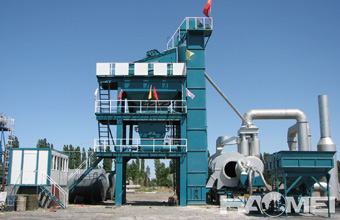
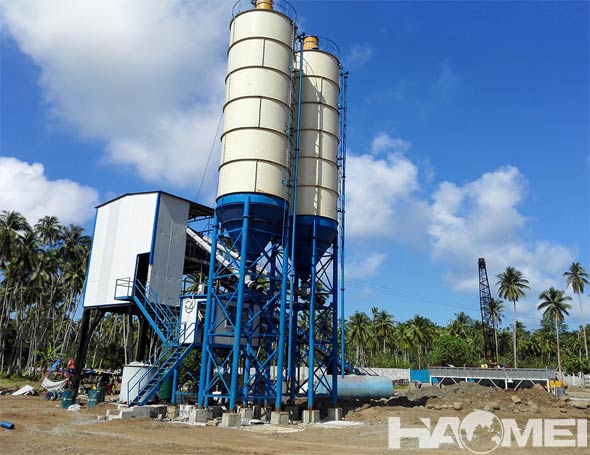
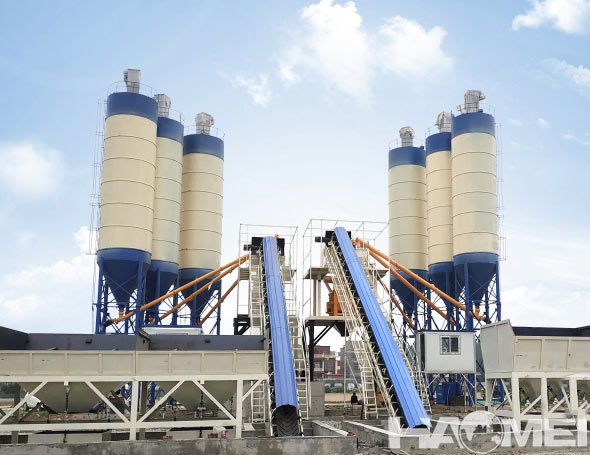
A stationary concrete mixing plant is not simply a matter of "anywhere it fits, it works." Site size and layout directly affect construction costs and production efficiency. Bucket elevator structures offer vertical feeding and require less horizontal space; the HZS35 model occupies only about 10m x 6m, making it suitable for urban construction sites and rural stations with limited space. Belt conveyors require a pre-planned inclined conveying corridor; the HZS90 concrete batching plant model occupies approximately 22m x 10m, suitable for long-term operation sites with ample space. Simultaneously, the site's foundation conditions must be assessed: standard stationary concrete plants only require a level, hardened ground with a bearing capacity ≥150kPa; high-capacity concrete mixing stations require reinforced concrete foundations, increasing construction time and costs. When selecting a model, prioritize configurations that match site conditions to avoid additional site modifications.
Third: Configuration matching–Focus on core components and maintain performance baselines.
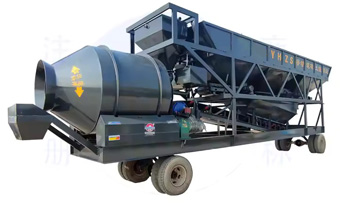
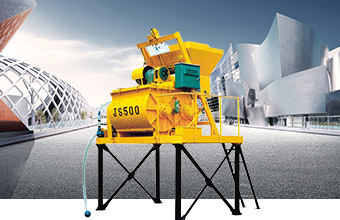
Price differences for the same model of stationary concrete mixer plant equipment primarily stem from quality variations in the three core components: the main unit, metering, and steel structure. Regarding the mixing unit, the JS series units are available in standard and reduced power versions. Taking the JS1000 as an example, the standard version with dual 18.5kW drive motors can operate at full load for extended periods, while the reduced-power version is prone to overload failures. Wear-resistant parts made of thickened high-manganese steel have a service life exceeding 7000 hours, while ordinary materials only last 3000-4000 hours. For the metering system, standard export models use independent electronic weighing modules, with aggregate error ≤±2% and powder and liquid error ≤±1%, conforming to EN 206 international standards. Low-priced models often use simple metering devices, with errors generally exceeding the standard by more than 30%. When selecting a model, the specifications of core components must be clearly specified; do not rely solely on the model name.
Fourth: Long-term compatibility–Reserving expansion space to reduce overall lifetime costs.
The service life of a stationary concrete mixing plant is generally 5-10 years; therefore, model selection must consider future upgrade needs. Modular design models are preferred, allowing for the addition of environmental modules such as pulse dust collectors and sand/gravel separators as needed without requiring overall modification. The control system should have expansion interfaces to connect to production management systems and accommodate long-term operational upgrades. For overseas markets, attention should also be paid to parts compatibility and after-sales response capabilities. Models with CE certification and core components using internationally standardized specifications should be selected to avoid problems such as difficulty in purchasing and long waiting times for parts during maintenance.
Essentially, there is no absolutely best stationary concrete mixer plant, only the solution most suitable for the project's needs. Haomei Machinery can provide customized selection advice based on the client's project scale, site conditions, and budget, accurately matching across four dimensions to help clients select cost-effective, long-term production equipment.


